
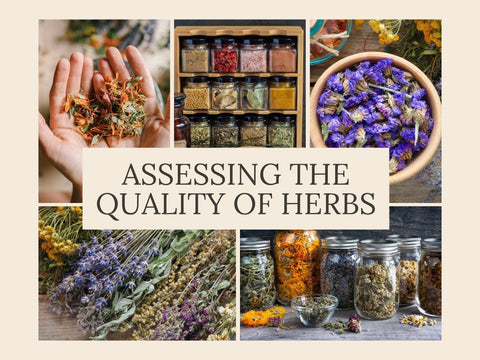
When we think about assessing the quality of herbs, it is easy to picture a laboratory filled with complex and expensive equipment. And while lab testing absolutely has an important place, especially in commercial manufacturing and formal quality control, most people buying herbs for themselves are not going to send every bag of peppermint or chamomile out for testing. Fortunately, there is still a great deal we can learn about the quality of an herb without doing so.
Our own senses are powerful - and free - tools here. The use of our senses to determine the identity and quality of plant materials is called organoleptic assessment. Not simply a traditional or informal practice, the American Herbal Products Association recognizes organoleptic analysis as a legitimate method for botanical identification and quality assessment, and has published specific guidance for its use.
There is so much information in what we see, smell, taste and feel, and yet because these things are so ordinary we don’t always think of them as precise tools. We use them all the time with food without really thinking about it. We know when lettuce is wilted, when an apple is mealy, or the difference between a strawberry that is pale and hard and one that is bright red, fragrant and just soft enough. Herbs really aren’t so different.
The Idea of Vitalism
Herbs are not simply bags of phytochemicals. They are not stagnant and they are not perfectly consistent.
Think about wine, or coffee beans. People can talk at length about the differences between two wines made from the same grape depending on the year, the weather, the soil, where the grapes were grown, when they were harvested and how they were processed afterward. Coffee is much the same, and plants used as herbs are subject to those same kinds of variables.
A chamomile flower grown through a very hot, dry season is not necessarily going to be exactly the same as one grown somewhere else in a cooler climate. The soil is different. The rainfall is different. The growing conditions are different.
And then we harvest it. From there even more changes happen. Plant materials are dried, sometimes heated, cut, ground, transported, stored, exposed to light, air and moisture. Some may sit much longer than others before they ever reach us.
With so many variables it can start to feel daunting to figure out what a “good quality” herb even means, but I think we already understand much of it intuitively. What is it that draws us to the most vibrant red strawberry in a bunch? Why do we choose one that is firm, but not too hard and not squishy? We are looking for something at its peak. Freshness, abundance, vitality.
Vitalism itself is a broad philosophy in traditional herbalism, but part of it is recognizing that plants are living things rather than static collections of constituents. They change throughout their lives. They react to their environment. They move resources around depending on what they are doing and what time of year it is.
When harvesting plant material, we think about where the plant is putting its energy and when. That can make a big difference.
Mullein is a Good Example
Mullein is a biennial, meaning its normal life cycle takes place over two growing seasons. During its first year it stays fairly close to the ground and produces that familiar soft rosette of leaves.
All summer those leaves are photosynthesizing and supporting the growth of the plant, while the root is building reserves that will help it survive the Winter. Then in its second year everything changes. The plant begins using those reserves to send up the huge flowering stalk that most people recognize as Mullein. That stalk can become several feet tall and eventually produces its flowers and seeds.
So if I am interested in harvesting mullein root, Fall of the first year makes sense. The plant has spent the Summer building those root reserves but has not yet had to start using them.
Once you start thinking about plants this way, harvest timing becomes a lot easier to understand. It isn’t just, “roots are harvested in Fall because that is the rule.” You can ask what the plant itself is doing. Where are its resources? Is it growing leaves? Flowering? Producing seed? Preparing for winter?
Of course every plant is a little different, and there are exceptions to broad harvesting rules, but understanding the life cycle gives you somewhere to begin. Quality starts well before an herb reaches a bag, bottle or lab.

Organoleptic Assessment
Sensory qualities are not separate from chemistry. What we see, smell and taste are not just abstract representations of plant constituents, they are direct interactions with them. Aromatic compounds smell aromatic. Bitter constituents taste bitter. If I open a bag of peppermint and I can clearly smell that characteristic peppermint aroma, then the volatile compounds responsible for that aroma are still present in the plant material. They have to be, or I could not smell them.
Peppermint contains not one aromatic compound but dozens. Depending on the plant and the method used, laboratory analyses have identified 30, 40 or more different volatile constituents. A lab can separate and identify many of those at once using something like GC-MS, but even a basic analysis can easily cost $100 to $350 or more per sample, and actually quantifying individual compounds can become considerably more involved.
My nose may not tell me that a sample contains exactly 38% menthol or give me a chromatogram of everything present. But for many of the practical questions I am asking when assessing an herb, I don’t need it to. I can open a bag of dried peppermint from a supplier and compare it with peppermint freshly dried from my own garden. I can put samples from two suppliers side by side and immediately notice which has a stronger, fresher, more characteristic in its aroma, or whether one smells flat, stale or otherwise off. That gets me surprisingly far before I have spent hundreds of dollars trying to put numbers to something my senses are already telling me.
Look at it
Color is one of the first things I notice. That does not mean brighter is always better. Some herbs are naturally much duller in color than others. But if something that should still be green arrives almost entirely brown, I notice that. If flowers that are normally brightly colored have faded almost completely, I notice that too.
I also look at what is actually in the bag. If I ordered leaf, am I getting leaf or mostly stem? Does the plant material look reasonably consistent? Is there anything mixed in that clearly should not be there? Does it actually resemble the plant part I ordered?
This can sound almost too simple, but looking closely catches a lot, and much like learning plant identification out in nature, the more you look, the more you notice. You do not need to know what a petiole is or be able to describe a leaf as lanceolate before you begin paying attention. The first step is just to look.
Think about walking through a park before you know the names of many plants. At first it can all blur together as “green.” But if you keep looking, you start noticing that one plant always grows in a damp spot, another has leaves arranged in a particular way, another appears earlier in spring, another has a texture or color that starts to feel familiar. Later, when a field guide or a mentor gives you the name, genus, botanical terms or uses, there is already something in your mind for that information to attach to.
The same thing happens with dried herbs. You begin to recognize what good peppermint usually looks like, or notice that one bag contains far more stem or older leaf than another. Eventually, distinctions that sounded intimidating on paper can become surprisingly obvious because your brain is very good at recognizing patterns once you give it enough examples.
Education still matters, especially when distinguishing potentially dangerous plants or lookalike species. But you do not have to wait until you feel educated enough to start observing. Start looking first. The vocabulary and finer distinctions can come as you build experience.
Smell it
For aromatic herbs, smell is one of the easiest quality checks. Take a little of the herb and smell it, then crush it between your fingers and smell it again.
Good rosemary should smell like rosemary. That sounds obvious, but compare a fresh, strongly aromatic batch of rosemary beside one that has sat in a poorly sealed jar for years and the difference can be enormous. The older material may still be rosemary. It just may not be very good rosemary anymore.
The same idea applies to peppermint, thyme, fennel, lavender and plenty of other aromatic plants. If something should be intensely aromatic and it smells mostly like dry grass or dust, that tells me something.
Taste it
Taste can give us surprisingly specific information. Of course, only taste an herb once you know what it is and know that it is safe and appropriate for you to taste.
Echinacea root is one of my favorite examples. A good Echinacea tincture produces a distinctive tingly and almost numbing sensation. That sensation is associated with a family of fat-soluble constituents called alkamides, including the wonderfully named dodeca-2E,4E,8Z,10E/Z-tetraenoic acid isobutylamides, which are among the major alkamides found in the root. You don't need to know that name to recognize the sensation. If one sample gives you a strong, characteristic tingle and another barely does, you can recognize that something is present in relatively greater or lesser amounts long before you know exactly what molecule is responsible. Your tongue may not be able to tell you the concentration in milligrams, but it can tell you that two samples are meaningfully different.
Astringency gives us another good example because it isn't really a “taste” at all. That dry, puckering feeling you get from strong black tea or certain barks and leaves comes largely from tannins interacting with proteins in your saliva. Again, you can quite literally feel phytochemistry happening in your mouth.
Start by noticing what happens. Is it bitter, sweet, sour or pungent? Does your mouth become dry? Does your tongue tingle? Does heat build slowly or immediately? With enough tasting and comparison, you begin to recognize when familiar qualities are strongly present, barely present, or missing altogether, and that alone can tell you quite a lot about the herb in front of you.
Packaging and Handling
Even a beautiful herb can lose quality through poor handling. Once a plant has been harvested, we are basically trying to preserve as much of its quality as possible, and there are a surprising number of steps between a plant growing in a field and that same plant reaching us in a bag. Harvesting, drying, cutting, sifting, storage, transportation and packaging can all preserve quality or slowly chip away at it.
Light matters. Heat matters. Moisture matters. Oxygen matters. Time matters. Not every herb responds exactly the same way, which is part of why good processing requires some actual knowledge of the plants being handled rather than treating herbs as interchangeable raw materials.
Powders are one place I pay particular attention. Grinding an herb dramatically increases its surface area and exposes much more of it to oxygen. That can mean aroma and freshness are lost much faster than they would be in an intact leaf, root, seed or bark. For that reason I usually prefer whole or cut-and-sifted herbs when it is practical and grind them myself when I need powder.
Packaging matters too. If I can smell a supposedly sealed bag of rosemary before I open it, I don’t necessarily take that as evidence that the rosemary is wonderfully aromatic. It can also mean the volatile compounds are escaping through the packaging.
Moisture is another major concern. Herbs need to be properly dried before storage and kept dry afterward. Dampness, condensation, mold, strange clumping or a musty smell are all things I would take seriously.
And then there is age. I think “dried” sometimes gets confused with “preserved forever.” It isn’t. A five-year-old jar of rosemary may still contain rosemary, but it probably doesn’t resemble the rosemary that originally went into the jar. No amount of beautiful packaging or testing at the end can put back quality that was lost somewhere along the way.
What About the Supplier?
If you aren’t growing or harvesting the herbs yourself, part of evaluating quality becomes evaluating who you are buying them from. This is something I have come to appreciate more and more. We aren't just buying an herb, we are buying the result of a whole chain of decisions made by growers, harvesters, processors, importers and suppliers before it ever reaches us.
I love local herbs and will happily choose locally grown material when it makes sense. But local does not automatically mean high quality. Neither does organic. They can both be useful and meaningful pieces of information, but neither one tells you everything.
I want to know what plant I am actually buying. What is the botanical name and plant part? Where was it grown? When was it harvested? How has it been dried and stored? Can the supplier trace it back to a particular lot and, ideally, tell me something about where it came from? Do they have specifications for what acceptable material should look, smell or taste like? And what testing has been done?
Traceability can sound like paperwork, but it gives context to the herb in front of you. If something is unusually wonderful, or unusually poor, there is some chance of understanding why.
You may not find every answer printed on a retail package, particularly when buying herbs casually for home use, but good suppliers should be able to answer reasonable questions. And I think willingness to know and talk about where their herbs came from tells you something in itself.
COAs and Laboratory Testing
A Certificate of Analysis, usually called a COA, is a document that reports information and testing associated with a material or a particular lot.
COAs are incredibly useful, but simply having a COA does not automatically mean an herb is high quality. You have to look at what was actually tested.
Depending on the material, a COA may include things like identity testing, microbial results, moisture, heavy metals, pesticide residues, mycotoxins or other tests. Those can answer questions that our senses simply cannot.
I cannot smell lead, and I cannot look at an herb and reliably tell you whether it contains pesticide residues. This is exactly where laboratory testing becomes indispensable.
At Sprig, we look at supplier documentation, identity, organoleptic characteristics and laboratory testing as different pieces of the same quality system. One does not replace all the others.
Finding Better Herbs at Home
If you are buying herbs for yourself, you don't need to make this overly complicated. Start with a supplier that is clear about what they are selling. Look for the botanical name and plant part. Buy a smaller quantity the first time you use a new supplier, and pay attention to the packaging.
Then when the herbs arrive, spend a little time with them. Open the bag, look at them, smell them, crush them between your fingers, brew them, and taste them when it is safe and appropriate to do so.
If you already have a particularly good sample of the same herb, compare them. It is surprising how obvious some differences become when two batches are sitting right beside each other.
And over time you build experience. You stop asking only, “Is this acceptable?” You begin to know what really high quality peppermint can smell like, how vibrant dried flowers can still be, and ultimately what has retained its vitality.
The more time you spend around herbs, the more you notice. And I think that is really the point.
Comments (0)
There are no comments for this article. Be the first one to leave a message!