
A whole herb tincture, a standardized herbal extract and an isolated compound that originally came from a plant can all be described as plant based, but they are very different things.
At Sprig, we work primarily with whole herb extracts. That choice does not come from believing that natural is always better, distrusting laboratories, or rejecting modern phytochemistry. Quite the opposite. The more I learn about plant chemistry, the less inclined I am to assume that identifying one important compound means we understand the plant.
My preference also comes from traditional herbalism and the enormous body of observation that came before modern analytical equipment. People have been growing, preparing, tasting and observing plants for thousands of years. A single person's experience is an anecdote. Patterns observed repeatedly across generations and practitioners deserve more consideration than that.
Modern analytical tools give us another way of looking. Chromatography can separate compounds our senses could never distinguish and measure them with remarkable precision. But precision can also tempt us to mistake detail for completeness. Knowing an extraordinary amount about a handful of constituents does not mean we understand everything happening in the plant, much less everything that happens when that chemistry meets a complex human body.
I value both ways of looking. But when there isn't a compelling reason to reduce the plant further, I prefer keeping more of it together.

What Do These Terms Mean?
When I say a whole herb extract, I mean something like a traditional tincture, infusion or decoction intended to extract a broad range of constituents rather than concentrating one particular molecule.
Even “whole herb extract” is imperfect language. A tincture does not contain the whole plant. Water extracts certain things well, alcohol extracts others and oil has an affinity for different constituents again. Temperature, alcohol percentage, time and preparation method all change what ends up in the finished preparation.
Extraction itself is already a selection.
A standardized extract goes another step. One or more constituents are measured and the extract is produced or adjusted so those constituents fall within a particular range from batch to batch. The rest of the plant chemistry does not necessarily disappear. A standardized extract may still contain a very complicated mixture.
Then there are isolated compounds, where one constituent has been separated from that larger mixture.
As we move along that spectrum, we gain greater control over a particular piece of the chemistry while carrying less of everything else along with it.
There Are Good Reasons to Standardize
Plant variability isn't always something I want to preserve.
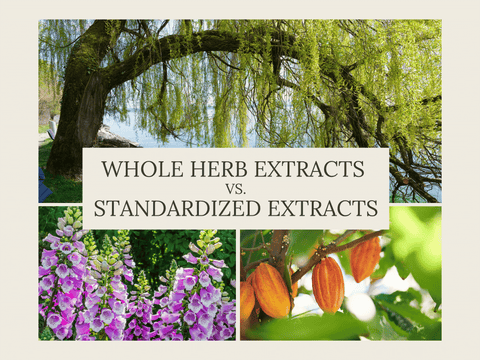
Foxglove is a good example. Foxglove species contain extremely potent cardiac glycosides, chemistry that eventually gave us drugs including digoxin, a medicine used in certain heart conditions to help control heart rate and improve how strongly the heart contracts. Even purified digoxin has a narrow therapeutic range, where relatively small differences in dose or blood concentration can mean the difference between effective and seriously toxic.
This is one place where I have no interest in returning to the whole plant. Dose accuracy and consistency are a matter of life and death. Experimenting with Foxglove as a whole herb is dangerous and irresponsible, and in my view this is firmly outside the purview of an herbalist and belongs with qualified medical practitioners who can dose, monitor and respond appropriately.
I value complexity in plants, but I don't think it is always an advantage. Sometimes reducing that complexity gives us something genuinely useful: control.

What Do We Mean by “The Active”?
One phrase I am cautious around in herbalism is the active ingredient.
Sometimes there really is one particularly powerful constituent. Other times there are several, or one changes the absorption or metabolism of another. Constituents may enhance, reduce or otherwise change one another's effects.
Then we add the person taking the herb. Human beings differ in metabolism, enzymes, genetics, microbiomes and plenty of other ways that can influence what happens after a preparation is consumed.
Complex systems get complicated quickly.
That doesn't mean every molecule in a plant matters to us or that everything we haven't identified yet is secretly beneficial. Some compounds may be present in amounts too small to matter at all.
But if an extract is standardized to 5% of compound X, I still want to know why X was chosen. Is it responsible for a substantial part of what the plant does? Is it mainly a useful marker of consistency? And what do we know about everything that isn't X?
Even when we have identified an important constituent, I think there is another question: does it behave the same way when we deliberately change its proportion relative to everything around it? Sometimes the answer may be yes. Sometimes that may be exactly what makes a preparation more useful. But I don't assume that automatically.
We can only standardize for something we have identified and decided is worth measuring. Sometimes that decision rests on excellent evidence. Other times a constituent is useful because it gives manufacturers something consistent to measure - or consistent for marketing.
Consistency is valuable. But a precise measurement of one part should not be confused with complete understanding of the whole.
Willow, Meadowsweet and Wintergreen
Willow is a good example of what I mean when I question the idea of the active.
We know its salicylates matter. Salicin from Willow is ultimately converted into salicylic acid in the body, and this same family of chemistry led to the development of aspirin.
It would be easy, then, to assume we found the important part of Willow and understand how it works.
Except the amount of salicylic acid produced from a typical standardized Willow extract is well below what we would normally use as an aspirin dose for pain. And yet Willow extracts have still shown benefit in controlled pain studies. Researchers themselves have questioned whether the salicylates alone can explain that effect.
To me, that makes salicin an active, not necessarily the active.
Willow also contains flavonoids, polyphenols and plenty of other chemistry that may be contributing. Salicin gave us an important piece of the picture. I don't think it gave us the whole explanation.
Meadowsweet and Wintergreen contain related salicylate chemistry too, but in different forms and alongside very different surrounding constituents.
We found something important when we found the salicylates. What interests me is how much there still seems to be left to understand.

Flavor Is Part of the Chemistry
Plant chemistry isn't only simplified in pursuit of a more predictable medicinal effect. Sometimes processors reduce or remove constituents simply because consumers prefer the flavor that way, and this is something I am particularly reluctant to do. At Sprig we work with herbs in things people eat and drink, so I think about this constantly. The heat of Cayenne, bitterness of Cacao and aromatics of Peppermint or Rosemary aren't qualities sitting on top of the “real” chemistry. They are part of it.
Cacao is a good example. Dutch processing makes Cacao darker, mellower and less bitter, but it can also substantially reduce the polyphenols that contribute to that bitterness. The Cacao is not being standardized in the technical sense, but some of its chemical complexity is being reduced largely for flavor.
I don't think bitterness is something we should automatically process away. Bitter is part of the experience of many herbs and foods, and repeated exposure can make it feel less intense and more familiar over time. The more comfortable our palate becomes with bitter flavors, the easier it is to appreciate foods and drinks that don't need to lean so heavily on sweetness.
That is part of why I don't want Cayenne with the heat engineered out or Cacao processed until its bitterness disappears. The character of the plant is part of what I want to preserve.
Flavor isn't a perfect measure of quality or activity. But when a plant is deliberately made to taste less like itself, I want to know what else changed along the way.
What Are We Trying to Carry With Us?
Even a “whole herb extract” is selective. A Nettle infusion, Nettle tincture and Nettle infused into oil will each pull different chemistry from the same plant. Water, alcohol, vinegar, honey and oils have been used to extract plants for a very long time, each carrying something a little different with them.
So I don't think the question is whether we alter or extract plants. Of course we do.
The more interesting question to me is what we are trying to carry forward, and what we are willing to leave behind.
For most of the extracts I make at Sprig, my answer is: I’m trying to preserve quite a lot of it.
The Tradeoff
There is a tradeoff here that I think whole-herb practitioners should be honest about.
Plants vary, people vary, and a non-standardized extract will not affect everyone in exactly the same way. That is one reason I am cautious about sweeping claims.
In my own practice, and at Sprig, I prefer working with herbs that have a wide margin of safety, sourcing them carefully, testing for contaminants and then encouraging people to pay attention to their own experience. How does it taste? What do you notice? Does a little feel different from a lot? Do you notice anything at all?
That experience has real value for the person having it. It doesn't necessarily tell us what someone else will experience.
Standardized extracts and isolated compounds make much more specific clinical research possible because researchers can define what was given and at what dose. That gives us a stronger foundation for making specific claims for people in general. Even then, people do not all respond identically.
I am comfortable admitting that uncertainty rather than pretending herbs are more predictable than they are.
Why We Choose Whole-Herb Extracts
So are whole-herb extracts always better? No. But I am not neutral about the question either.
My preference isn't based on an assumption that natural automatically means safe or effective, and it isn't a rejection of modern phytochemistry. I value chromatography, clinical trials and analytical chemistry. I just don't consider them the beginning and end of useful knowledge about a plant.
An herbalist tasting Willow, noticing the tingle of Echinacea, comparing two batches of Peppermint, or observing that the same herb seems to fit one person's pattern but not another's is gathering information too. Traditional herbalism developed ways of organizing those observations and looking for patterns across plants and people. When similar observations recur across generations and practitioners, I don't think they should be dismissed as though they were one person's anecdote. Modern tools can investigate those observations more deeply, confirm them, challenge them, or show us things nobody knew to look for.
I like extracts that still smell, taste and behave recognizably like the plants they came from. I like retaining a broad range of constituents rather than concentrating one simply because it is the constituent we currently understand best as “the active.”
There are tradeoffs. Plants vary, so whole-herb extracts vary too. Good sourcing, thoughtful formulation, organoleptic assessment and laboratory testing matter enormously. So does paying attention to the person actually taking the herb.
For me, the more closely we learn to look at plants, the less interested I am in reducing them too quickly. That complexity is much of what I am trying to preserve.
Comments (0)
There are no comments for this article. Be the first one to leave a message!